Algebra
13–15 questions · about 35%
- Linear equations in one variable
- Linear equations in two variables
- Linear functions
- Systems of two linear equations in two variables
- Linear inequalities in one or two variables
Taught in: Algebra 1
What the Digital SAT Math section actually tests, domain by domain and skill by skill, based on the College Board's test specifications, plus the answer-entry rules that cost students points. SparklMind tutors SAT Math 1-on-1, starting with a free 45-minute diagnostic.
The College Board divides the Math section into four content domains, each tested through a set of specific skills. Here is every skill, and the school course it comes from.
13–15 questions · about 35%
Taught in: Algebra 1
13–15 questions · about 35%
Taught in: Algebra 2
5–7 questions · about 15%
Taught in: Algebra 1 and statistics units
5–7 questions · about 15%
Taught in: Geometry
Source: College Board, Digital SAT test specifications (College Board, the SAT Math section (opens in a new tab)).
About a quarter of SAT Math questions have no answer choices: you type the answer in. A correct value entered in the wrong form can be marked wrong, so these rules are worth knowing before test day.
Source: College Board, Bluebook student-produced response directions (College Board, Bluebook (opens in a new tab)).
Percentages look easy, which is exactly why this Problem-Solving and Data Analysis question catches so many students.
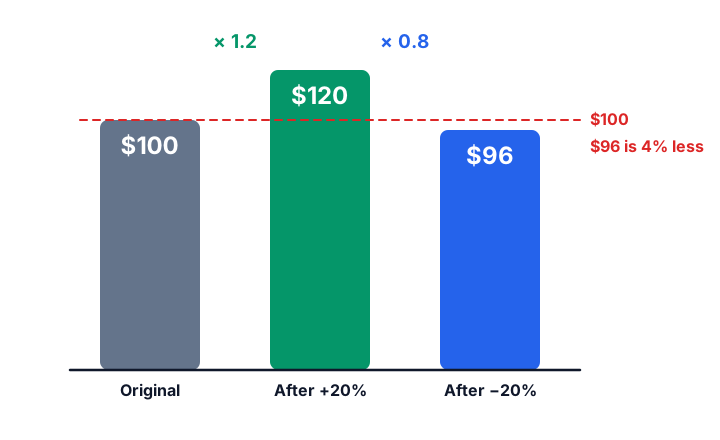
A jacket's price is raised by 20%. Later, the new price is lowered by 20%. The final price is what percent less than the original price?
Step 1: use multipliers, not additions. A 20% increase multiplies the price by 1.2; a 20% decrease multiplies it by 0.8.
Step 2: combine them. 1.2 × 0.8 = 0.96, so the final price is 96% of the original.
Answer: it is 4% less than the original. As a typed answer, enter 4, without the % sign.
The trap is answering 0% because "+20 and −20 cancel". They do not, because the 20% decrease is taken from a larger price. Picking a real number, such as $100 → $120 → $96, is a quick way to check.
SparklMind tutors the Digital SAT Math section 1-on-1: the same tutor every session, all four domains, when to use Desmos and when algebra is faster, and pacing for the adaptive modules. It starts with a free 45-minute diagnostic; sessions are $59 each after that.
SAT Math tutoring, test format and prices →Mostly it is Algebra 1, Algebra 2 and Geometry, with some right-triangle trigonometry and statistics. There is no calculus. The difference is the style: the SAT rewards spotting the fastest method, and many questions are word problems.
A reference sheet is available in the Bluebook app with area and circumference formulas, the Pythagorean theorem, special right triangles, common volume formulas, and facts about angles and radians. Formulas like the slope formula, the quadratic formula and the equation of a circle are not on it, so they need to be memorized.
Algebra and Advanced Math, with 13–15 questions each, together make up about 70% of the section. Problem-Solving and Data Analysis and Geometry and Trigonometry have 5–7 each.
No. Wrong answers and blanks score the same, so every question should get an answer.
Yes. The PSAT/NMSQT tests the same four domains in the same digital format, so this guide applies to it as well.
Free practice: the Digital SAT Math exam hub has a practice quiz and formula flashcards for every domain.