Change
Derivatives describe how a quantity changes; integrals add those changes up.
What each unit of AP Calculus AB covers, how much of the exam it is worth, and where students most often lose points, based on the College Board's course description. SparklMind tutors the course 1-on-1, starting with a free 45-minute diagnostic.
The College Board organizes the course into eight units. The weight is each unit's share of the exam score, and the last line of each card is where students most often lose points.
Limits from graphs, tables and algebra, the squeeze theorem, types of discontinuity, and the Intermediate Value Theorem.
Common trouble spot: Justifying continuity with all three conditions, not just "the graph has no gap".
The derivative as a limit, when a function is differentiable, and the power, product and quotient rules.
Common trouble spot: Recognizing a derivative written as a limit of a difference quotient.
The chain rule, implicit differentiation, derivatives of inverse and inverse trig functions, and higher-order derivatives.
Common trouble spot: Forgetting the chain rule's inner derivative, especially inside implicit differentiation.
Rates of change in context, straight-line motion, related rates, local linear approximation and L'Hôpital's rule.
Common trouble spot: Related rates: substituting known values before differentiating.
The Mean Value and Extreme Value Theorems, increasing and decreasing intervals, concavity, the first and second derivative tests, and optimization.
Common trouble spot: Justifications: naming the test and the sign change, not just stating the answer.
Riemann sums, the definite integral, the Fundamental Theorem of Calculus, antiderivatives and u-substitution.
Common trouble spot: Accumulation questions that give a rate and ask for an amount at a later time.
Writing differential equations from a situation, slope fields, separation of variables, and exponential growth and decay.
Common trouble spot: Forgetting the constant of integration, or applying the initial condition too late.
Average value, motion and accumulation, area between curves, and volumes by cross sections, discs and washers.
Common trouble spot: Setting up the right integral for a volume, especially washers.
Source: College Board, AP Calculus AB and BC Course and Exam Description (College Board, AP Calculus AB course (opens in a new tab)).
Every unit connects to three big ideas, and the exam scores four mathematical practices. The practices are why a correct answer can still lose points.
Derivatives describe how a quantity changes; integrals add those changes up.
Both derivatives and integrals are built on limits, which is why the course starts there.
Using derivatives and integrals to say what a function does: where it rises, peaks, bends and accumulates.
Related rates (Unit 4) is one of the most-missed topics in AP Calculus AB, almost always for the same reason.
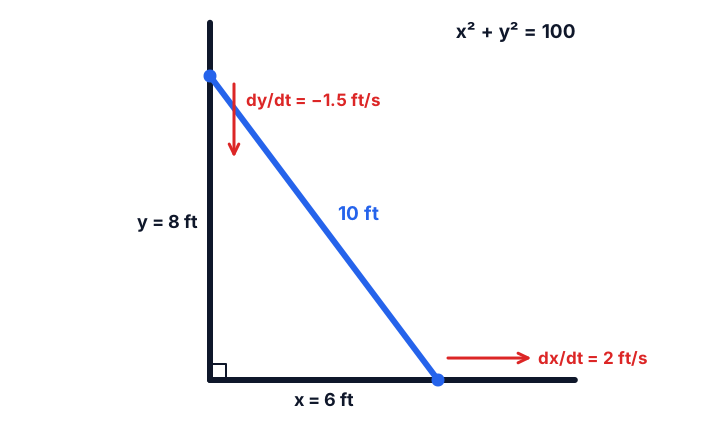
A 10-foot ladder leans against a wall. Its bottom slides away from the wall at 2 feet per second. How fast is the top sliding down the wall when the bottom is 6 feet from the wall?
Step 1: relate the quantities. Let x be the distance from the wall to the bottom and y the height of the top. The ladder never changes length, so x² + y² = 100.
Step 2: differentiate with respect to time. 2x · dx/dt + 2y · dy/dt = 0.
Step 3: now substitute. When x = 6, y = √(100 − 36) = 8, and dx/dt = 2. So 2(6)(2) + 2(8) · dy/dt = 0, giving dy/dt = −24/16 = −1.5.
Answer: the top slides down at 1.5 feet per second (dy/dt is negative because the height is decreasing).
The common mistake is substituting x = 6 in Step 1, before differentiating. A fixed number has derivative zero, so the rate you need disappears. Differentiate first, substitute second.
SparklMind tutors AP Calculus AB 1-on-1: the same tutor every session, following your child's class unit by unit, with released free-response questions marked against the official scoring guidelines. It starts with a free 45-minute diagnostic; sessions are $59 each after that.
AP Calculus tutoring, exam format and prices →Precalculus: functions and their graphs, exponential and logarithmic functions, and trigonometry, all fluent. Most trouble in AB traces back to a precalculus gap rather than the calculus.
Units 5 and 6, Analytical Applications of Differentiation (15–18%) and Integration and Accumulation of Change (17–20%), together make up about a third of the exam score.
The AB topics are all in BC, and the BC exam reports an AB subscore. BC then adds more integration techniques, Euler's method, logistic growth, parametric and polar functions, and infinite series.
Often, but it depends on the college. Each college sets its own policy on which AP scores earn credit or placement, so check the colleges your child is considering.
Some do, using the College Board's course materials and released free-response questions. The part that is hardest to learn alone is justification, since it needs someone to mark the reasoning, not just the answer.
Before AB: Precalculus. Going further: AP Calculus BC. Free practice: the AP Calculus exam hub.