Expressions and equations
Simplifying expressions, solving linear equations and inequalities, and rearranging formulas for a given variable.
One tutor works with your child every session on the unit their Algebra 1 class is on this week, from linear equations to quadratics, and stops them at the step where it goes wrong. It starts with a free 45-minute diagnostic, then sessions are $59 each, with no enrollment fee.
Course names and order vary by district, but most Algebra 1 classes follow the Common Core high-school algebra and functions standards, or a state version of them. These are the main strands tutoring works through.
Simplifying expressions, solving linear equations and inequalities, and rearranging formulas for a given variable.
Slope, intercepts, slope-intercept and point-slope form, and reading a linear relationship from a table, graph or word problem.
Solving two equations at once by graphing, substitution and elimination, and setting them up from a real situation.
Exponent rules, growth and decay, and telling linear change from exponential change.
Adding, subtracting and multiplying polynomials, and factoring, including trinomials and the difference of squares.
Graphs of parabolas, and solving quadratics by factoring, completing the square and the quadratic formula.
Center and spread, scatter plots, lines of best fit, and interpreting what a model says about the data.
Geometry proofs, Algebra 2, precalculus and calculus all assume Algebra 1 is automatic. A shaky foundation here shows up as trouble years later.
The SAT Math section's Algebra domain, about 35% of the questions, is Algebra 1 content: linear equations, linear functions and systems.
Several states give an Algebra 1 end-of-course exam, such as the STAAR Algebra I in Texas, the Regents Algebra I in New York and the Algebra 1 EOC in Florida.
It starts with a free 45-minute diagnostic on the unit your child's class is on right now. Within a day you get a written plan: which skills need repair, how many weeks that takes, and what the first month covers. After that, the same tutor teaches every session, working through this week's actual homework on a shared whiteboard. Your child does the solving; the tutor stops them at the step where it goes wrong. Every mistake goes into an error journal, and the recording and notes land in your dashboard within two hours.
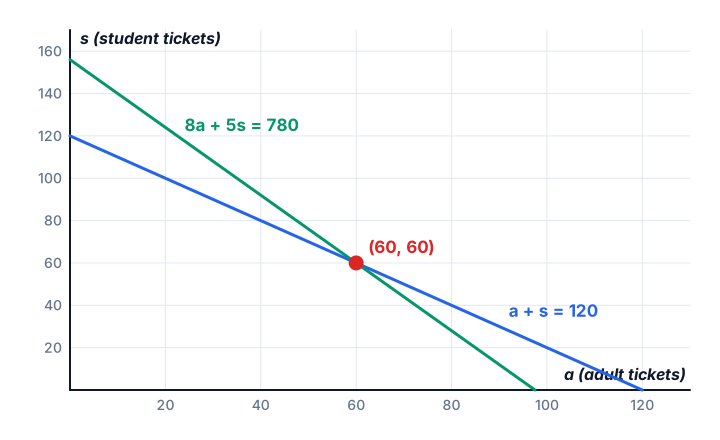
Most students can solve a system of equations once it is written down. The hard part is writing it down, so that is where sessions spend the time.
A school play sold 120 tickets and took in $780. Adult tickets cost $8 and student tickets cost $5. How many adult tickets were sold?
Step 1: name the unknowns. Let a be the number of adult tickets and s the number of student tickets.
Step 2: one equation per fact. Tickets: a + s = 120. Money: 8a + 5s = 780.
Step 3: substitute. From the first equation, s = 120 − a. Then 8a + 5(120 − a) = 780, so 8a + 600 − 5a = 780, which gives 3a = 180 and a = 60.
Step 4: check. 60 adult and 60 student tickets: 60 + 60 = 120 tickets, and 60 × $8 + 60 × $5 = $480 + $300 = $780. ✓
The common mistake is mixing the two facts into one equation, like a + s = 780. Writing one equation per fact, and checking the answer against both, catches it every time.
No enrollment fee. See all plans, or small-group classes for a lower hourly price.
Most US students take it in 8th or 9th grade, depending on their district and math track. Tutoring follows whichever year and course your child is in.
Yes. Share the syllabus and the unit calendar in the first session. Course work maps to your state's standards and your district's adopted curriculum, and sessions stay a little ahead of class so school becomes review.
With the free diagnostic. Algebra 1 trouble usually starts earlier, with fractions, negative numbers or order of operations. If so, the tutor builds a short repair track and tells you plainly how many weeks it takes before regular unit work resumes.
Yes. If your state gives one, such as STAAR Algebra I, the Regents Algebra I or Florida's Algebra 1 EOC, the final weeks of the plan focus on its question types and on released past exams where the state publishes them.
Two 55-minute sessions a week is a good starting point. The diagnostic gives you a number for your child, and you can change it month to month.
Sessions follow your school's rules. Where calculators are allowed, students learn to use Desmos to check work, but the core skills, like solving and factoring, are practiced by hand first.
Next in the sequence: Geometry and Algebra 2. Preparing for the SAT? See SAT Math tutoring.