Congruence and transformations
Translations, reflections, rotations and dilations, and using them to explain why two figures are congruent.
One tutor works with your child every session on the unit their Geometry class is on, from transformations to circles, and teaches proofs one reason at a time until they stop being the scary part. It starts with a free 45-minute diagnostic, then sessions are $59 each, with no enrollment fee.
Course order varies by district, but most Geometry classes follow the Common Core high-school geometry standards, or a state version of them. These are the main strands tutoring works through.
Translations, reflections, rotations and dilations, and using them to explain why two figures are congruent.
Two-column and paragraph proofs about lines, angles, triangles and parallelograms, the part of the course most students find hardest.
Similar triangles, the Pythagorean theorem, special right triangles, and sine, cosine and tangent.
Arcs, chords, tangents, inscribed angles, arc length and sector area, and radian measure.
Distance and midpoint formulas, slopes of parallel and perpendicular lines, and the equation of a circle.
Areas of polygons and circles, and surface area and volume of prisms, cylinders, pyramids, cones and spheres.
Geometry is where most students first have to justify every step, not just reach an answer. That habit carries into every later math course.
The SAT Math section's Geometry and Trigonometry domain, about 15% of the questions, covers area and volume, triangles, right-triangle trigonometry and circles.
New York gives a Regents Geometry exam and Florida gives a Geometry end-of-course exam.
It starts with a free 45-minute diagnostic on the unit your child's class is on right now, and a written plan within a day. After that, the same tutor teaches every session on a shared whiteboard with GeoGebra and Desmos in the same window, so figures are drawn and moved, not just described. Your child writes the proofs and works the problems; the tutor stops them at the step where the reasoning breaks. Every mistake goes into an error journal, and the recording and notes land in your dashboard within two hours.
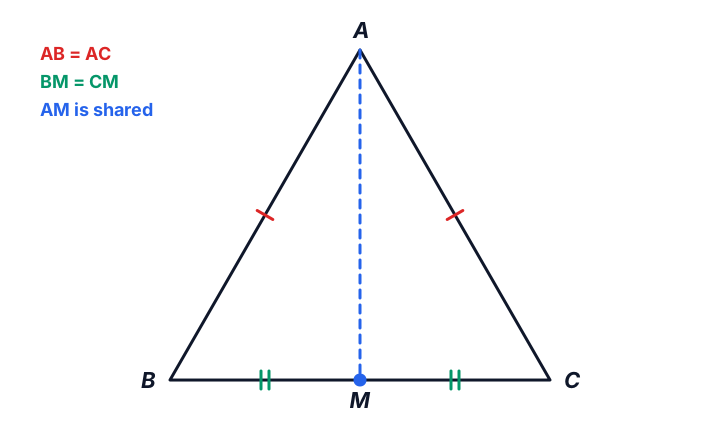
Proofs feel hard because every line needs a reason. Here is a short one, the kind sessions start with, showing how each statement earns its place.
Given: triangle ABC with AB = AC, and M the midpoint of BC. Prove: ∠B = ∠C.
| Statement | Reason |
|---|---|
| 1. AB = AC | Given |
| 2. M is the midpoint of BC | Given |
| 3. BM = CM | Definition of midpoint |
| 4. AM = AM | Reflexive property |
| 5. △ABM ≅ △ACM | SSS congruence |
| 6. ∠B = ∠C | Corresponding parts of congruent triangles are congruent (CPCTC) |
The idea: drawing AM splits the triangle into two triangles that match side for side, so their angles match too. The common mistake is writing ∠B = ∠C early, as if it were given. A proof may only use what is given or already proved, which is why the congruence has to come first.
No enrollment fee. See all plans, or small-group classes for a lower hourly price.
Most US students take it in 9th or 10th grade, often between Algebra 1 and Algebra 2. Tutoring follows whichever course and year your child is in.
That is the most common Geometry problem. Proofs are a skill of their own: knowing which fact to use next and what reason justifies it. Sessions build that skill with short proofs first, every reason said out loud, until writing them becomes routine.
Yes. Share the syllabus and unit calendar in the first session. Course work maps to your state's standards and your district's adopted curriculum, and sessions stay a little ahead of class.
Yes. The final weeks of the plan focus on that exam's question types and on released past exams where the state publishes them.
On a shared whiteboard with GeoGebra and Desmos open in the same window, so figures are drawn, measured and moved rather than described.
Two 55-minute sessions a week is a good starting point. The diagnostic gives you a number for your child, and you can change it month to month.
Before Geometry: Algebra 1. After it: Algebra 2 and Precalculus. Preparing for the SAT? See SAT Math tutoring.