Functions and transformations
Domain and range, composition and inverses, and how shifting, stretching and reflecting changes a graph and its equation.
One tutor works with your child every session on the unit their Precalculus or AP Precalculus class is on, making functions, logarithms and trigonometry reliable before calculus. It starts with a free 45-minute diagnostic, then sessions are $59 each, with no enrollment fee.
Precalculus courses vary more than most. Some are mainly trigonometry, others mainly functions. These are the topics most courses include, and tutoring follows the order your child's class uses.
Domain and range, composition and inverses, and how shifting, stretching and reflecting changes a graph and its equation.
Zeros, end behavior, asymptotes and holes, and reading a function's behavior from its equation.
Modeling growth and decay, properties of logarithms, and solving exponential and logarithmic equations.
The unit circle, graphs of the six trig functions, identities, inverse trig functions, and solving trig equations.
The laws of sines and cosines for any triangle, and vectors in the plane.
Polar coordinates and graphs, parametric equations, and complex numbers in polar form.
Arithmetic and geometric sequences and series, and an intuitive first look at limits, the starting point of calculus.
Most mistakes in calculus are not calculus: they are a trig identity, a log rule or an algebra step. Precalculus is where those tools become reliable.
Both cover functions, exponentials and logarithms, and trigonometry. AP Precalculus adds a College Board exam in May, which tutoring prepares for as well.
Knowing what a function's graph looks like before plotting it saves time on every later test, including the SAT's Advanced Math questions.
Taking AP Precalculus? The AP tutoring page has the exam format and the College Board unit weights.
It starts with a free 45-minute diagnostic on the unit your child's class is on right now, including the Algebra 2 skills it relies on, and a written plan within a day. After that, the same tutor teaches every session on a shared whiteboard with Desmos open, so each function is graphed and its behavior seen, not just computed. Your child does the solving; the tutor stops them at the step where it goes wrong. Every mistake goes into an error journal, and the recording and notes land in your dashboard within two hours.
Trig equations often have several solutions, and students regularly find one and stop. This is the kind of problem sessions use to build the habit of finding them all.
Solve 2 sin²x − sin x − 1 = 0 for 0 ≤ x < 2π.
Step 1: see it as a quadratic. Let u = sin x. Then 2u² − u − 1 = 0, which factors as (2u + 1)(u − 1) = 0.
Step 2: solve for sin x. sin x = 1 or sin x = −½.
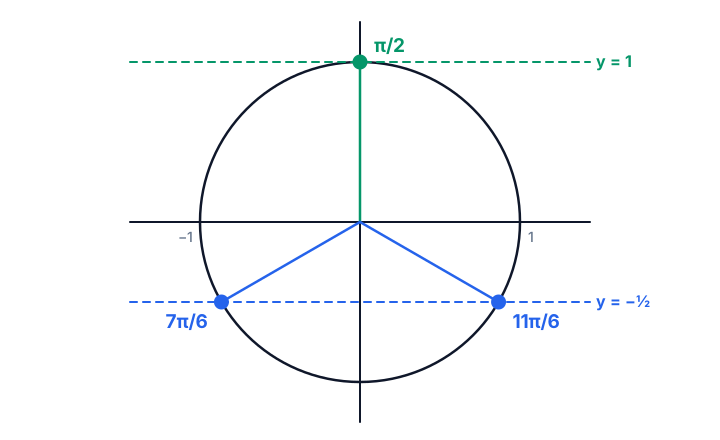
Step 3: find every angle. sin x = 1 only at x = π/2. sin x = −½ is negative, so x is in the third or fourth quadrant, with reference angle π/6: x = 7π/6 or x = 11π/6.
Answer: x = π/2, 7π/6, 11π/6.
The common mistakes are dividing both sides by sin x, which throws solutions away, and giving only one of the two angles for sin x = −½. The unit circle, sketched first, shows exactly how many answers to expect.
No enrollment fee. See all plans, or small-group classes for a lower hourly price.
Most US students take it in 11th or 12th grade, after Algebra 2, and before AP Calculus or college calculus. Tutoring follows whichever course your child is in.
Yes. AP Precalculus covers the same core topics and adds the College Board exam in May. See AP tutoring for the exam format and how each unit is weighted.
If calculus is next, a few weeks spent making trig identities, log rules and function transformations automatic pays off quickly. The free diagnostic will tell you honestly if it isn't needed.
Yes. Share the syllabus and unit calendar in the first session. Course work maps to your state's standards and your district's curriculum, and sessions stay a little ahead of class.
Where the course allows it. Desmos is open in every session so functions can be graphed and explored, but students also learn to sketch and reason without it, since some tests do not allow a calculator.
Two 55-minute sessions a week is a good starting point. The diagnostic gives you a number for your child, and you can change it month to month.
Before Precalculus: Algebra 2. After it: AP Calculus AB and AP Calculus BC.