Polynomial functions
Dividing polynomials, the remainder and factor theorems, finding zeros, and sketching graphs from their end behavior.
One tutor works with your child every session on the unit their Algebra 2 class is on, from polynomials to logarithms and trigonometry, and checks the Algebra 1 skills underneath as they go. It starts with a free 45-minute diagnostic, then sessions are $59 each, with no enrollment fee.
Course names vary: some schools call it Algebra II, others Algebra 2 and Trigonometry. Most follow the Common Core Algebra II standards or a state version of them. These are the main strands tutoring works through.
Dividing polynomials, the remainder and factor theorems, finding zeros, and sketching graphs from their end behavior.
Simplifying rational expressions, solving rational and radical equations, rational exponents, and spotting extraneous solutions.
Imaginary and complex numbers, and the complex solutions of quadratic equations.
Growth and decay models, logarithms and their properties, and solving exponential equations with logs.
Radians, the unit circle, graphs of sine and cosine, and modeling periodic situations.
Arithmetic and geometric sequences, and finding the sum of a geometric series.
The normal distribution, sampling, and what a margin of error or a study's conclusion really supports.
Functions, logarithms and trigonometry from Algebra 2 are used constantly in precalculus and calculus, so gaps here come back later.
The SAT Math section's Advanced Math domain, about 35% of the questions, covers the nonlinear, exponential, polynomial and rational functions taught in Algebra 2.
Students in New York can take the Regents Algebra II exam.
It starts with a free 45-minute diagnostic on the unit your child's class is on right now, which also checks the Algebra 1 skills this unit depends on. Within a day you get a written plan. After that, the same tutor teaches every session on a shared whiteboard with Desmos open, so each new function is graphed and explored, not just manipulated on paper. Your child does the solving; the tutor stops them at the step where it goes wrong. Every mistake goes into an error journal, and the recording and notes land in your dashboard within two hours.
Logarithms are where many Algebra 2 students get stuck. They are just the tool for getting a variable out of an exponent, and this is the kind of problem sessions use to show why.
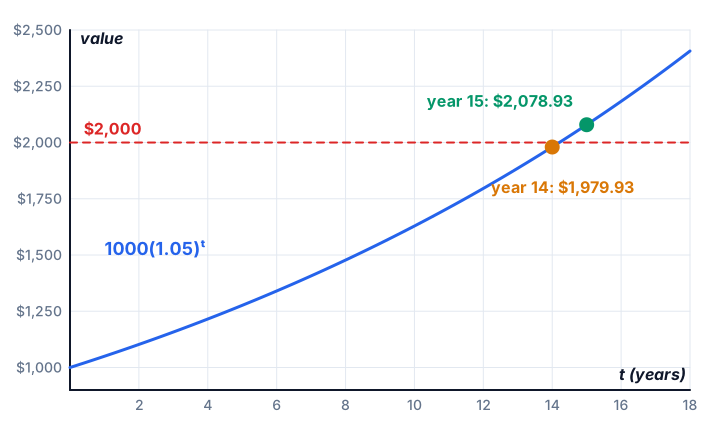
$1,000 is invested at 5% interest, compounded once a year. After how many whole years will it first be worth at least $2,000?
Step 1: write the model. After t years the investment is worth 1000(1.05)t. Set it equal to 2000: 1000(1.05)t = 2000.
Step 2: isolate the power. Divide by 1000: (1.05)t = 2.
Step 3: take logs of both sides. t · log(1.05) = log 2, so t = log 2 ÷ log 1.05 ≈ 0.3010 ÷ 0.0212 ≈ 14.2.
Step 4: answer the question asked. Interest is added once a year, so after 14 years it is worth 1000(1.05)14 ≈ $1,979.93, still short, and after 15 years ≈ $2,078.93. The answer is 15 years.
Two common mistakes: dividing 2 by 1.05 instead of taking logs, and answering 14.2 when the question asks for whole years. Checking the answer against the original situation catches the second one.
No enrollment fee. See all plans, or small-group classes for a lower hourly price.
Most US students take it in 10th or 11th grade, after Algebra 1 and usually Geometry. Tutoring follows whichever course and year your child is in.
It moves from linear relationships to many kinds of functions at once, and it assumes Algebra 1 skills like factoring are automatic. Students who struggle in Algebra 2 often have an Algebra 1 gap, which the free diagnostic checks for first.
Yes. Share the syllabus and unit calendar in the first session. Course work maps to your state's standards and your district's adopted curriculum, and sessions stay a little ahead of class.
Yes. The final weeks of the plan focus on the Regents question types and on released past exams, which New York publishes.
Yes. Much of the SAT's Advanced Math domain is Algebra 2 content. For focused SAT preparation, see SAT Math tutoring.
Two 55-minute sessions a week is a good starting point. The diagnostic gives you a number for your child, and you can change it month to month.
Before Algebra 2: Algebra 1 and Geometry. After it: Precalculus. Preparing for the SAT? See SAT Math tutoring.