
Your first class is free: 45 minutes, 1-on-1, no card needed.

Book

AP Calculus BC: the 10 units, explained

What AP Calculus BC covers, what it adds beyond AB, and how much of the exam each unit is worth, based on the College Board's course description. SparklMind tutors BC 1-on-1, starting with a free 45-minute diagnostic.

The 10 units of AP Calculus BC

BC includes every AB unit plus two more. Units 1–5 carry less of the BC exam than they do on AB, because Units 9 and 10 take up about 30% of the score. The weight is each unit's share of the BC exam.

AP Calculus BC units, exam weighting and BC-only topics
UnitExam weightBC-only content
1. Limits and Continuity4–7%Same as AB
2. Differentiation: Definition and Fundamental Properties4–7%Same as AB
3. Differentiation: Composite, Implicit, and Inverse Functions4–7%Same as AB
4. Contextual Applications of Differentiation6–9%Same as AB
5. Analytical Applications of Differentiation8–11%Same as AB
6. Integration and Accumulation of Change17–20%Integration by parts, partial fractions with linear factors, and improper integrals
7. Differential Equations6–9%Euler's method and logistic growth models
8. Applications of Integration6–9%Arc length of a smooth curve
9. Parametric Equations, Polar Coordinates, and Vector-Valued Functions11–12%The whole unit is BC-only
10. Infinite Sequences and Series17–18%The whole unit is BC-only

For what Units 1–8 cover in detail, and where students lose points in each, see the AP Calculus AB guide.

Source: College Board, AP Calculus AB and BC Course and Exam Description (College Board, AP Calculus BC course (opens in a new tab)).

The two BC-only units

Unit 9: Parametric, Polar and Vector-Valued Functions

Derivatives and arc length of parametric curves, motion described by vectors (position, velocity, speed and acceleration), and slopes and areas in polar coordinates.

Common trouble spot: confusing velocity with speed, and setting up the area between two polar curves.

Unit 10: Infinite Sequences and Series

Convergence tests (nth-term, integral, comparison, alternating series and ratio), power series, radius and interval of convergence, Taylor and Maclaurin series, and error bounds.

Common trouble spot: choosing the right convergence test, and forgetting to check the endpoints of an interval.

An interval of convergence, including the endpoints

Finding the radius of convergence is usually quick. Most lost points come from the endpoints, which need a different test each.

Find the interval of convergence of the series Σ (x − 2)n ⁄ (n · 3n), for n = 1, 2, 3, …

Step 1: ratio test. The ratio of consecutive terms tends to |x − 2| ⁄ 3 as n → ∞. The series converges when |x − 2| ⁄ 3 < 1, that is |x − 2| < 3, so −1 < x < 5 and the radius is 3.

Step 2: check x = 5. The series becomes Σ 1 ⁄ n, the harmonic series, which diverges.

Step 3: check x = −1. The series becomes Σ (−1)n ⁄ n. Its terms alternate in sign, decrease, and tend to 0, so it converges by the alternating series test.

Answer: the interval of convergence is −1 ≤ x < 5.

The ratio test says nothing at the endpoints, where the ratio equals exactly 1, which is why each endpoint needs its own test. Stopping at −1 < x < 5 is the most common way to lose this point.
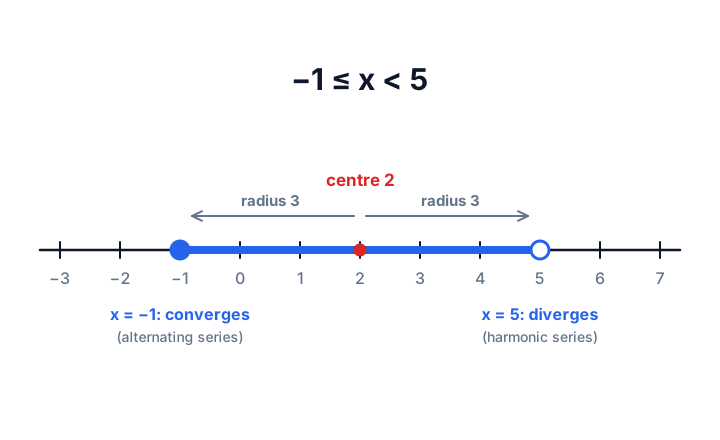
Number line with the interval from minus 1 to 5 marked, a filled point at minus 1 and an open point at 5.
Centre 2, radius 3. The endpoint −1 is included and 5 is not: −1 ≤ x < 5.

AP Calculus BC tutoring

SparklMind tutors AP Calculus BC 1-on-1: the same tutor every session, following your child's class unit by unit, with extra time on series and on released free-response questions marked against the official scoring guidelines. It starts with a free 45-minute diagnostic; sessions are $59 each after that.

AP Calculus tutoring, exam format and prices →

AP Calculus BC questions

What does AP Calculus BC cover that AB does not?

All of AB, plus integration by parts, partial fractions and improper integrals, Euler's method and logistic growth, arc length, and two whole extra units: parametric, polar and vector-valued functions (Unit 9) and infinite sequences and series (Unit 10).

Should my child take AB or BC?

It depends on how solid their precalculus is and what their school offers. BC covers roughly one and a half AB courses in a year, so it suits students who are fluent with functions, logarithms and trigonometry. The free diagnostic gives an honest view.

Can students take BC without taking AB first?

Many schools let strong students go straight from precalculus to BC; others require AB first. Tutoring follows whichever route your child's school uses.

What is the AB subscore on the BC exam?

The BC exam reports a separate AB subscore, based on the questions covering AB topics. So a student who takes BC also shows how they did on the AB portion.

Which BC units carry the most marks?

Units 6 and 10, Integration and Accumulation of Change (17–20%) and Infinite Sequences and Series (17–18%). Series is also the unit students most often find hardest, so it gets extra session time.

See also: AP Calculus AB guide, Precalculus, and free practice in the AP Calculus BC exam hub.