Calculus
Limits through definite integrals and differential equations. It carries the most marks, and it is taught to Advanced depth rather than Main depth.
Not a 200-student batch running at one speed. One teacher works on the chapters where you are losing marks, ends every session with a timed set of past-year questions, and analyses every mock mark by mark. It starts with a free diagnostic.
JEE Main (Paper 1) is the qualifying exam for NITs, IIITs and other institutes, and the route to JEE Advanced. Here is how the mathematics section is set, according to the NTA information bulletin.
Because every wrong answer costs a mark, including in Section B, leaving a question you cannot solve is often the right call. Sessions practise deciding quickly which questions to attempt. JEE Advanced is set by the IITs, has two compulsory papers, and changes its question types from year to year, so Advanced preparation focuses on problem-solving depth rather than a fixed format.
Every unit is covered. Time is not spread evenly, though: the chapters below get the most 1-on-1 hours because they carry the most marks and the most mistakes.
Limits through definite integrals and differential equations. It carries the most marks, and it is taught to Advanced depth rather than Main depth.
Straight lines through conics. Largely mechanical once the standard results are in muscle memory, which makes it a reliable scoring block.
Among the most dependable marks on the paper. A couple of weeks of focused drilling usually secures this chapter.
Short, closed questions that appear almost every year. Drilled until each one takes under two minutes.
Quadratics, complex numbers, sequences and binomial theorem, where JEE Advanced tends to hide its trick questions.
Conditional probability and Bayes' theorem, practised on multi-part, Advanced-style problems.
Source: NTA, JEE Main information bulletin, mathematics syllabus (National Testing Agency, JEE Main (opens in a new tab)).
About twenty minutes of concept, then forty of you solving while the teacher watches your working, because the mistake is almost never in the final line. You are stopped at the step where it goes wrong, not marked wrong at the end. Every session closes with a timed set of past-year questions, and every mistake goes into an error journal that your revision is built from. Each full mock you sit is analysed mark by mark.
This integral cannot be done by finding an antiderivative. The trick is a property of definite integrals that JEE uses again and again.
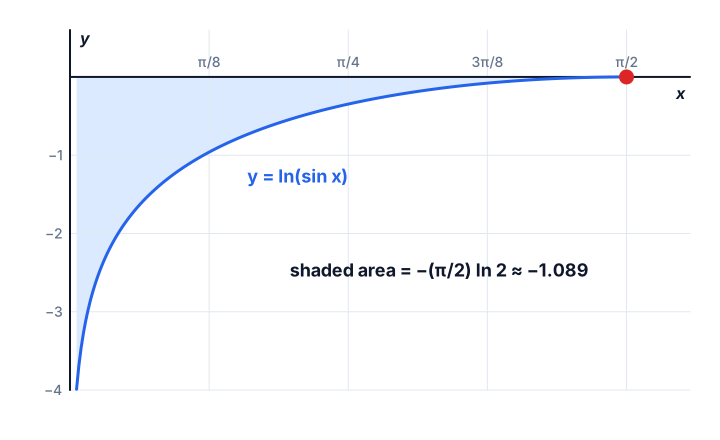
Evaluate I = ∫₀^(π/2) ln(sin x) dx.
Step 1. Use ∫₀^a f(x) dx = ∫₀^a f(a − x) dx with a = π/2. Since sin(π/2 − x) = cos x, this gives I = ∫₀^(π/2) ln(cos x) dx.
Step 2. Add the two forms: 2I = ∫₀^(π/2) ln(sin x cos x) dx = ∫₀^(π/2) ln(sin 2x) dx − (π/2) ln 2, using sin x cos x = (sin 2x)/2.
Step 3. Substitute t = 2x: ∫₀^(π/2) ln(sin 2x) dx = ½ ∫₀^π ln(sin t) dt = ½ · 2I = I, because the curve is symmetric about π/2.
Step 4. So 2I = I − (π/2) ln 2, which gives I = −(π/2) ln 2.
The common slip is in Step 3: forgetting that the substitution doubles the upper limit to π, then halving the wrong quantity. That is exactly the kind of mistake the error journal is for.
Practise on your own with the free JEE Main exam hub or the JEE Advanced hub, and browse solved past papers in the PYQ archive.
No two-year lock-in and no admission fee. See all plans.
It can be. A batch cannot stop for one person's weak chapter. 1-on-1 sessions cover only the chapters where you are losing marks, alongside your batch.
Both, and they are taught differently. Main is about speed and accuracy on standard question forms; Advanced is multi-concept problems where the difficulty is seeing the setup. The diagnostic decides the mix for you.
Every lost mark gets a reason: a concept gap, a calculation slip, or running out of time. Those three need different fixes, so the next week of sessions is built from that analysis.
If there are fewer than four months left and the fundamentals are missing, a maths score cannot be rebuilt from scratch, and the diagnostic will say so rather than sell you sessions. Four to eight months of focused 1-on-1 work is where it pays off.
No. SparklMind is a mathematics practice. You can keep your batch for the other two subjects.
Yes. Your error journal and chapter gap map move with you, so a new teacher starts from where you are, not from a fresh diagnostic.