Class 5–7
Foundation Maths
The years where math quietly goes wrong. We rebuild number sense before it becomes a Class 9 problem.
Fractions & decimals · Ratio and proportion · Basic mensuration
One teacher, one student, and the exact chapter your school is on this week, for CBSE, ICSE and state boards in India and Grades 5 to 12 in the US. The first class is a free diagnostic that finds where any gap really started.
Every track is taught 1-on-1 and re-paced whenever school moves faster or slower. Classes 10 and 12 add board exam preparation with past papers and the marking scheme.
Class 5–7
The years where math quietly goes wrong. We rebuild number sense before it becomes a Class 9 problem.
Fractions & decimals · Ratio and proportion · Basic mensuration
Class 8–9
Polynomials and linear equations taught until the student can explain the step back to you.
Polynomials · Linear equations · Quadratics intro
Class 9–10
Proof writing, circle theorems and heights & distances — the three chapters that decide the board score.
Circle theorems · Similarity & proofs · Heights and distances
Class 10
Chapter-wise past papers, timed. Each lost mark gets traced back to the concept behind it.
Past 10 years papers · Timed full mocks · Error journal
Class 11
Limits, derivatives and integrals built slowly, so Class 12 and entrance prep sit on something solid.
Limits & continuity · Differentiation · Integration basics
Class 12
Full board coverage with the marking scheme in front of us — presentation earns marks too.
Definite integrals · Vectors & 3D · Probability
Preparing for JEE? See JEE Mathematics.
The usual high school sequence, following your district's courses and state standards. Grades vary by district and math track, so tutoring follows the course your child is actually in.
Grades 5–8
Fractions, ratios, negative numbers, expressions and early equations: the foundations every later course assumes.
Grade 8 or 9
Linear equations, functions, systems, factoring and quadratics.
Grade 9 or 10
Proofs, transformations, triangles, circles and right-triangle trigonometry.
Grade 10 or 11
Polynomials, rational functions, logarithms and trigonometric functions.
Grade 11 or 12
Functions, trigonometry, vectors and polar, in regular or AP form.
Grade 11 or 12
Limits, derivatives, integrals and, in BC, series.
Preparing for the SAT? See SAT Math topics and SAT Math tutoring.
Class 5 to 7, or Grades 5 to 8, are the years where maths quietly goes wrong. A gap in fractions or negative numbers rarely shows up at the time. It shows up years later as "my child is bad at algebra". The free diagnostic works backwards from the current chapter until it finds where the gap actually started.
The same mistake, three years apart
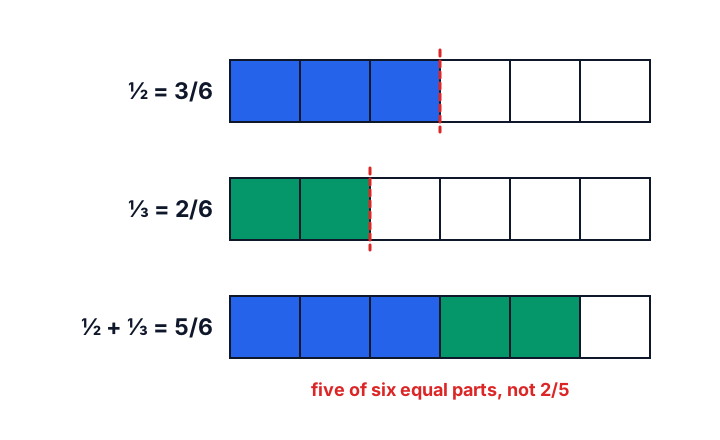
Class 6 / Grade 6: ½ + ⅓. The tempting answer is 2/5, adding tops and bottoms. The correct method uses a common denominator: 3/6 + 2/6 = 5/6.
Class 9 / Algebra 1: x/2 + x/3. A student who never fixed the fraction habit writes 2x/5. The same common denominator gives 3x/6 + 2x/6 = 5x/6.
The algebra is not the problem; the fraction is. Re-teaching the algebra chapter would not fix it, which is why the diagnostic goes back to where the gap began.
The first class is a free diagnostic, and there is no admission fee. See all plans, or compare 1-on-1 and small-group tutoring.
Yes. Share the textbook and the school's chapter or unit plan in the first class. Lessons are sequenced to stay slightly ahead of school, so class time becomes revision instead of first exposure.
Yes. Share the textbook and chapter plan in the first class, and lessons follow that board's own chapter order, which often differs from CBSE by a whole term.
The free first class is a diagnostic. If there are gaps from earlier years, the teacher builds a short repair track and tells you plainly how many weeks it will take before regular chapter work resumes.
A common starting point is three a week, moving to two once the backlog clears, and more in a board exam year. You can change the number monthly.
Any time, without asking. Every class is also recorded and available in the dashboard within two hours.