
Your first class is free: 45 minutes, 1-on-1, no card needed.

Book

JEE Mathematics · formula sheet

Matrices and linear algebra

Determinants and inverses, the rules that connect them, solving systems, eigenvalues of a 2 × 2 matrix, the standard transformations, and vector products.

21 formulas and facts in 6 sections
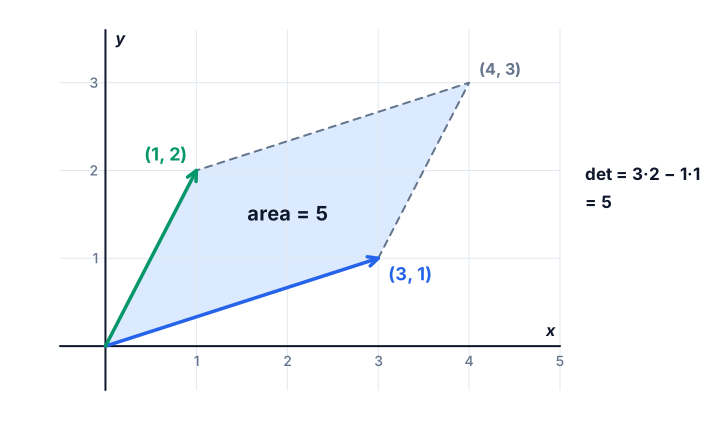
Parallelogram spanned by the vectors (3, 1) and (1, 2) on a grid, with its fourth corner at (4, 3).
The determinant of a 2×2 matrix is the area of the parallelogram its columns span: 3·2 − 1·1 = 5.

Determinants and inverses

Determinant of a 2 × 2 matrix
det⁡(abcd)=ad−bc\det\begin{pmatrix} a & b \\ c & d \end{pmatrix} = ad - bc
Inverse of a 2 × 2 matrix
(abcd)−1=1ad−bc(d−b−ca)\begin{pmatrix} a & b \\ c & d \end{pmatrix}^{-1} = \frac{1}{ad-bc}\begin{pmatrix} d & -b \\ -c & a \end{pmatrix}

It exists only when ad − bc ≠ 0.

Determinant of a 3 × 3 matrix (expanding along the first row)
∣abcdefghi∣=a(ei−fh)−b(di−fg)+c(dh−eg)\begin{vmatrix} a & b & c \\ d & e & f \\ g & h & i \end{vmatrix} = a(ei - fh) - b(di - fg) + c(dh - eg)
Inverse in general
A−1=1det⁡A adj⁡(A)A^{-1} = \frac{1}{\det A}\,\operatorname{adj}(A)

Rules

Determinants
det⁡(AB)=det⁡A⋅det⁡Bdet⁡(AT)=det⁡Adet⁡(A−1)=1det⁡A\det(AB) = \det A \cdot \det B \qquad \det(A^{T}) = \det A \qquad \det(A^{-1}) = \frac{1}{\det A}
Scalar multiple of an n × n matrix
det⁡(kA)=kndet⁡A\det(kA) = k^{n}\det A
Products reverse
(AB)−1=B−1A−1(AB)T=BTAT(AB)^{-1} = B^{-1}A^{-1} \qquad (AB)^{T} = B^{T}A^{T}
Invertibility
A is invertible  ⟺  det⁡A≠0A \text{ is invertible} \iff \det A \neq 0

Systems of equations

Matrix form
Ax=b  ⟹  x=A−1b(det⁡A≠0)A\mathbf{x} = \mathbf{b} \;\Longrightarrow\; \mathbf{x} = A^{-1}\mathbf{b} \quad (\det A \neq 0)
When det A = 0

The system has either no solution or infinitely many; row-reduce the augmented matrix to tell which.

Cramer's rule (2 unknowns)
x=∣ebfd∣∣abcd∣y=∣aecf∣∣abcd∣x = \frac{\begin{vmatrix} e & b \\ f & d \end{vmatrix}}{\begin{vmatrix} a & b \\ c & d \end{vmatrix}} \qquad y = \frac{\begin{vmatrix} a & e \\ c & f \end{vmatrix}}{\begin{vmatrix} a & b \\ c & d \end{vmatrix}}

For ax + by = e and cx + dy = f.

Eigenvalues

Definition
Av=λv,v≠0A\mathbf{v} = \lambda\mathbf{v}, \quad \mathbf{v} \neq \mathbf{0}
Characteristic equation
det⁡(A−λI)=0\det(A - \lambda I) = 0
For a 2 × 2 matrix
λ2−tr⁡(A) λ+det⁡A=0\lambda^{2} - \operatorname{tr}(A)\,\lambda + \det A = 0

The eigenvalues add up to the trace and multiply to the determinant.

Transformations of the plane

Rotation by θ anticlockwise about the origin
(cos⁡θ−sin⁡θsin⁡θcos⁡θ)\begin{pmatrix} \cos\theta & -\sin\theta \\ \sin\theta & \cos\theta \end{pmatrix}
Reflection in the x-axis and in the line y = x
(100−1)(0110)\begin{pmatrix} 1 & 0 \\ 0 & -1 \end{pmatrix} \qquad \begin{pmatrix} 0 & 1 \\ 1 & 0 \end{pmatrix}
Enlargement by scale factor k
(k00k)\begin{pmatrix} k & 0 \\ 0 & k \end{pmatrix}
Area scale factor
area of image=∣det⁡A∣×area of object\text{area of image} = |\det A| \times \text{area of object}

Vectors

Magnitude
∣a∣=a12+a22+a32|\mathbf{a}| = \sqrt{a_1^{2} + a_2^{2} + a_3^{2}}
Dot product
a⋅b=a1b1+a2b2+a3b3=∣a∣∣b∣cos⁡θ\mathbf{a}\cdot\mathbf{b} = a_1b_1 + a_2b_2 + a_3b_3 = |\mathbf{a}||\mathbf{b}|\cos\theta

Zero exactly when the vectors are perpendicular (for non-zero vectors).

Cross product
a×b=∣ijka1a2a3b1b2b3∣∣a×b∣=∣a∣∣b∣sin⁡θ\mathbf{a}\times\mathbf{b} = \begin{vmatrix} \mathbf{i} & \mathbf{j} & \mathbf{k} \\ a_1 & a_2 & a_3 \\ b_1 & b_2 & b_3 \end{vmatrix} \qquad |\mathbf{a}\times\mathbf{b}| = |\mathbf{a}||\mathbf{b}|\sin\theta

A reference for revision. In an exam, use the formula sheet your exam board provides and the notation your course uses.