
Your first class is free: 45 minutes, 1-on-1, no card needed.

Book

Geometry · formula sheet

Geometry: theorems and formulas

Triangles, coordinate geometry, the circle theorems, polygons, and the volume and surface-area formulas for the common solids.

20 formulas and facts in 5 sections
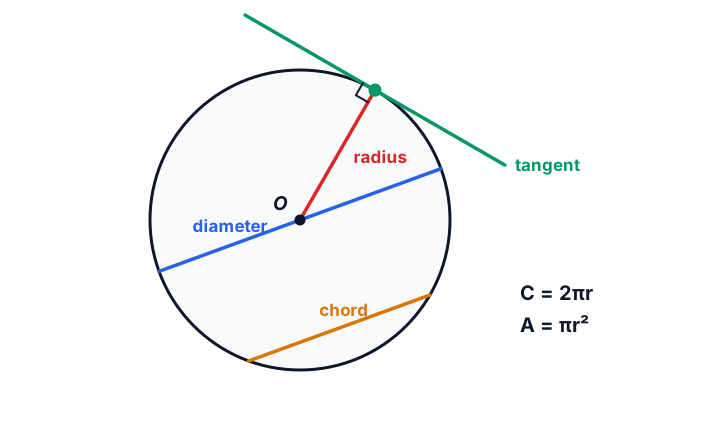
A circle with centre O showing a radius, a diameter, a chord and a tangent that meets a radius at a right angle.
The parts of a circle. A tangent is perpendicular to the radius at the point where it touches.

Triangles

Angle sum
∠A+∠B+∠C=180∘\angle A + \angle B + \angle C = 180^{\circ}
Area
Area=12bh\text{Area} = \frac{1}{2}bh
Pythagorean theorem (right triangles)
a2+b2=c2a^{2} + b^{2} = c^{2}
Congruence

Two triangles are congruent by SSS, SAS, ASA, AAS, or HL (right triangles). SSA and AAA do not prove congruence.

Similar triangles with scale factor k
side′side=kArea′Area=k2\frac{\text{side}'}{\text{side}} = k \qquad \frac{\text{Area}'}{\text{Area}} = k^{2}

Coordinate geometry

Distance
d=(x2−x1)2+(y2−y1)2d = \sqrt{(x_2-x_1)^{2} + (y_2-y_1)^{2}}
Midpoint
M=(x1+x22,  y1+y22)M = \left(\frac{x_1+x_2}{2},\; \frac{y_1+y_2}{2}\right)
Circle with centre (h, k) and radius r
(x−h)2+(y−k)2=r2(x-h)^{2} + (y-k)^{2} = r^{2}

Circles

Circumference and area
C=2πrA=πr2C = 2\pi r \qquad A = \pi r^{2}
Inscribed angle
inscribed angle=12 (intercepted arc)=12 (central angle)\text{inscribed angle} = \frac{1}{2}\,(\text{intercepted arc}) = \frac{1}{2}\,(\text{central angle})
Angle in a semicircle

An inscribed angle that stands on a diameter is 90°.

Tangents

A tangent is perpendicular to the radius at the point of contact. The two tangents drawn from one outside point are equal in length.

Intersecting chords
a⋅b=c⋅da \cdot b = c \cdot d

a, b and c, d are the two parts of each chord.

Tangent and secant from one point
(tangent)2=(whole secant)×(external part)(\text{tangent})^{2} = (\text{whole secant}) \times (\text{external part})

Polygons

Sum of interior angles (n sides)
(n−2)⋅180∘(n-2)\cdot 180^{\circ}
Each exterior angle of a regular polygon
360∘n\frac{360^{\circ}}{n}
Areas
parallelogram=bhtrapezoid=12(b1+b2)h\text{parallelogram} = bh \qquad \text{trapezoid} = \frac{1}{2}(b_1 + b_2)h

Solids

Prism and cylinder
V=BhVcyl=πr2hSAcyl=2πr2+2πrhV = Bh \qquad V_{\text{cyl}} = \pi r^{2}h \qquad SA_{\text{cyl}} = 2\pi r^{2} + 2\pi rh
Pyramid and cone
V=13BhVcone=13πr2hlateral areacone=πrℓV = \frac{1}{3}Bh \qquad V_{\text{cone}} = \frac{1}{3}\pi r^{2}h \qquad \text{lateral area}_{\text{cone}} = \pi r\ell

B is the area of the base; ℓ is the slant height.

Sphere
V=43πr3SA=4πr2V = \frac{4}{3}\pi r^{3} \qquad SA = 4\pi r^{2}

A reference for revision. In an exam, use the formula sheet your exam board provides and the notation your course uses.