
Your first class is free: 45 minutes, 1-on-1, no card needed.

Book

AP Calculus BC · formula sheet

AP Calculus BC: integration and series

Integration techniques, the convergence tests, the Taylor series worth knowing by heart, and the parametric, polar and differential-equation formulas.

27 formulas and facts in 5 sections
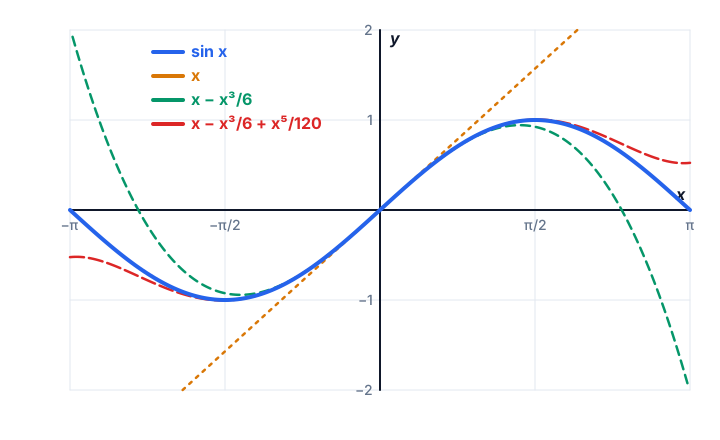
Graph of sin x together with its Taylor polynomials of degree 1, 3 and 5 about zero.
Each extra term of the Taylor series for sin x keeps the polynomial close to the curve over a wider interval.

Integration techniques

Integration by parts
∫u dv=uv−∫v du\int u\,dv = uv - \int v\,du
Improper integral
∫a∞f(x) dx=lim⁡b→∞∫abf(x) dx\int_a^{\infty} f(x)\,dx = \lim_{b\to\infty}\int_a^{b} f(x)\,dx

It converges when this limit exists and is finite.

Partial fractions (distinct linear factors)
px+q(x−a)(x−b)=Ax−a+Bx−b\frac{px+q}{(x-a)(x-b)} = \frac{A}{x-a} + \frac{B}{x-b}
Average value of f on [a, b]
favg=1b−a∫abf(x) dxf_{\text{avg}} = \frac{1}{b-a}\int_a^b f(x)\,dx

Antiderivatives to know

Reciprocal
∫1x dx=ln⁡∣x∣+C\int \frac{1}{x}\,dx = \ln|x| + C
Exponential
∫ex dx=ex+C∫ax dx=axln⁡a+C\int e^{x}\,dx = e^{x} + C \qquad \int a^{x}\,dx = \frac{a^{x}}{\ln a} + C
Trigonometric
∫sec⁡2x dx=tan⁡x+C∫sec⁡xtan⁡x dx=sec⁡x+C\int \sec^2 x\,dx = \tan x + C \qquad \int \sec x\tan x\,dx = \sec x + C
Inverse trigonometric
∫dx1+x2=arctan⁡x+C∫dx1−x2=arcsin⁡x+C\int \frac{dx}{1+x^2} = \arctan x + C \qquad \int \frac{dx}{\sqrt{1-x^2}} = \arcsin x + C

Convergence tests for series

nth-term test
lim⁡n→∞an≠0  ⟹  ∑an diverges\lim_{n\to\infty} a_n \neq 0 \;\Longrightarrow\; \sum a_n \text{ diverges}

If the limit is 0 the test says nothing.

Geometric series
∑n=0∞arn=a1−rfor ∣r∣<1\sum_{n=0}^{\infty} ar^{n} = \frac{a}{1-r} \quad\text{for } |r| < 1

It diverges when |r| ≥ 1.

p-series
∑n=1∞1np converges  ⟺  p>1\sum_{n=1}^{\infty} \frac{1}{n^{p}} \text{ converges} \iff p > 1
Ratio test
L=lim⁡n→∞∣an+1an∣L = \lim_{n\to\infty}\left|\frac{a_{n+1}}{a_n}\right|

L < 1: converges absolutely. L > 1: diverges. L = 1: inconclusive.

Alternating series test
∑(−1)nbn converges if bn>0,  bn+1≤bn,  lim⁡n→∞bn=0\sum (-1)^{n} b_n \text{ converges if } b_n > 0,\; b_{n+1} \le b_n,\; \lim_{n\to\infty} b_n = 0
Alternating series error bound
∣S−Sn∣≤bn+1|S - S_n| \le b_{n+1}
Integral test
∑n=1∞f(n) and ∫1∞f(x) dx converge or diverge together\sum_{n=1}^{\infty} f(n) \text{ and } \int_1^{\infty} f(x)\,dx \text{ converge or diverge together}

For f positive, continuous and decreasing on [1, ∞).

Limit comparison test
lim⁡n→∞anbn=c,  0<c<∞  ⟹  both converge or both diverge\lim_{n\to\infty}\frac{a_n}{b_n} = c,\; 0 < c < \infty \;\Longrightarrow\; \text{both converge or both diverge}

For series with positive terms.

Taylor and Maclaurin series

Taylor series about x = a
f(x)=∑n=0∞f(n)(a)n!(x−a)nf(x) = \sum_{n=0}^{\infty} \frac{f^{(n)}(a)}{n!}(x-a)^{n}
Exponential
ex=∑n=0∞xnn!for all xe^{x} = \sum_{n=0}^{\infty} \frac{x^{n}}{n!} \quad\text{for all } x
Sine and cosine
sin⁡x=∑n=0∞(−1)nx2n+1(2n+1)!cos⁡x=∑n=0∞(−1)nx2n(2n)!\sin x = \sum_{n=0}^{\infty} \frac{(-1)^{n}x^{2n+1}}{(2n+1)!} \qquad \cos x = \sum_{n=0}^{\infty} \frac{(-1)^{n}x^{2n}}{(2n)!}
Geometric
11−x=∑n=0∞xnfor ∣x∣<1\frac{1}{1-x} = \sum_{n=0}^{\infty} x^{n} \quad\text{for } |x| < 1
Natural logarithm
ln⁡(1+x)=∑n=1∞(−1)n+1xnnfor −1<x≤1\ln(1+x) = \sum_{n=1}^{\infty} \frac{(-1)^{n+1}x^{n}}{n} \quad\text{for } -1 < x \le 1
Lagrange error bound
∣Rn(x)∣≤M ∣x−a∣n+1(n+1)!|R_n(x)| \le \frac{M\,|x-a|^{n+1}}{(n+1)!}

M is at least the largest value of |f⁽ⁿ⁺¹⁾| between a and x.

Parametric, polar and differential equations

Slope of a parametric curve
dydx=dy/dtdx/dt\frac{dy}{dx} = \frac{dy/dt}{dx/dt}
Arc length (parametric)
L=∫ab(dxdt)2+(dydt)2 dtL = \int_{a}^{b} \sqrt{\left(\frac{dx}{dt}\right)^{2} + \left(\frac{dy}{dt}\right)^{2}}\,dt
Area in polar coordinates
A=12∫αβr2 dθA = \frac{1}{2}\int_{\alpha}^{\beta} r^{2}\,d\theta
Logistic growth
dPdt=kP(1−PL)\frac{dP}{dt} = kP\left(1 - \frac{P}{L}\right)

L is the carrying capacity; growth is fastest when P = L/2.

Euler's method
yn+1=yn+h f(xn,yn)y_{n+1} = y_n + h\,f(x_n, y_n)

A reference for revision. In an exam, use the formula sheet your exam board provides and the notation your course uses.