
Your first class is free: 45 minutes, 1-on-1, no card needed.

Book

Algebra 2 · formula sheet

Algebra 2 and trigonometry identities

Exponent and logarithm rules, complex numbers, sequences and series, the trigonometric identities, exact values, and the laws of sines and cosines.

19 formulas and facts in 6 sections
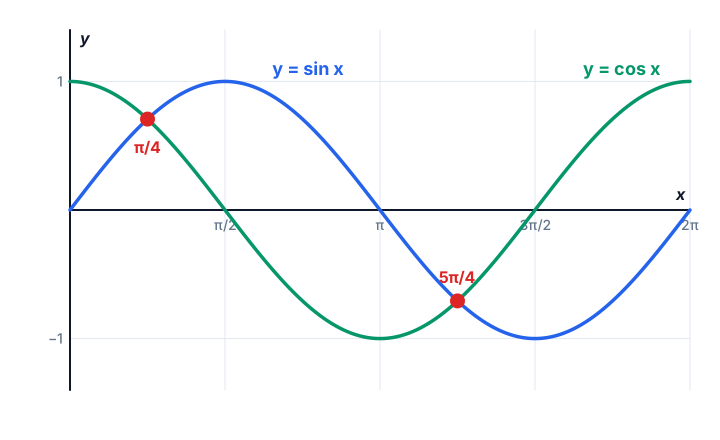
Graphs of sin x and cos x from 0 to 2 pi, crossing at pi over 4 and 5 pi over 4.
One period of sine and cosine. They are equal at π/4 and 5π/4.

Exponents and logarithms

Definition
log⁡bx=y  ⟺  by=x(b>0,  b≠1,  x>0)\log_b x = y \iff b^{y} = x \qquad (b > 0,\; b \neq 1,\; x > 0)
Product, quotient and power rules
log⁡b(xy)=log⁡bx+log⁡bylog⁡bxy=log⁡bx−log⁡bylog⁡bxk=klog⁡bx\log_b(xy) = \log_b x + \log_b y \qquad \log_b\frac{x}{y} = \log_b x - \log_b y \qquad \log_b x^{k} = k\log_b x
Change of base
log⁡bx=ln⁡xln⁡b\log_b x = \frac{\ln x}{\ln b}
Inverse relationships
blog⁡bx=xlog⁡bbx=xb^{\log_b x} = x \qquad \log_b b^{x} = x

Complex numbers

Imaginary unit
i2=−1i^{2} = -1
Conjugate product and modulus
(a+bi)(a−bi)=a2+b2∣a+bi∣=a2+b2(a+bi)(a-bi) = a^{2} + b^{2} \qquad |a+bi| = \sqrt{a^{2}+b^{2}}

Sequences and series

Arithmetic
an=a1+(n−1)dSn=n2(a1+an)a_n = a_1 + (n-1)d \qquad S_n = \frac{n}{2}(a_1 + a_n)
Geometric
an=a1r n−1Sn=a1(1−rn)1−r  (r≠1)a_n = a_1 r^{\,n-1} \qquad S_n = \frac{a_1(1-r^{n})}{1-r} \;(r \neq 1)
Infinite geometric series
S∞=a11−rfor ∣r∣<1S_{\infty} = \frac{a_1}{1-r} \quad\text{for } |r| < 1
Binomial theorem
(a+b)n=∑k=0n(nk)a n−kbk(nk)=n!k! (n−k)!(a+b)^{n} = \sum_{k=0}^{n} \binom{n}{k} a^{\,n-k} b^{k} \qquad \binom{n}{k} = \frac{n!}{k!\,(n-k)!}

Trigonometric identities

Pythagorean identities
sin⁡2θ+cos⁡2θ=11+tan⁡2θ=sec⁡2θ1+cot⁡2θ=csc⁡2θ\sin^{2}\theta + \cos^{2}\theta = 1 \qquad 1 + \tan^{2}\theta = \sec^{2}\theta \qquad 1 + \cot^{2}\theta = \csc^{2}\theta
Sum and difference
sin⁡(A±B)=sin⁡Acos⁡B±cos⁡Asin⁡Bcos⁡(A±B)=cos⁡Acos⁡B∓sin⁡Asin⁡B\sin(A \pm B) = \sin A\cos B \pm \cos A\sin B \qquad \cos(A \pm B) = \cos A\cos B \mp \sin A\sin B
Double angle
sin⁡2A=2sin⁡Acos⁡Acos⁡2A=cos⁡2A−sin⁡2A=2cos⁡2A−1=1−2sin⁡2A\sin 2A = 2\sin A\cos A \qquad \cos 2A = \cos^{2}A - \sin^{2}A = 2\cos^{2}A - 1 = 1 - 2\sin^{2}A
Double angle for tangent
tan⁡2A=2tan⁡A1−tan⁡2A\tan 2A = \frac{2\tan A}{1 - \tan^{2}A}

Exact values

Sine and cosine at the standard angles
θ0π6π4π3π2sin⁡θ01222321cos⁡θ13222120\begin{array}{c|ccccc} \theta & 0 & \tfrac{\pi}{6} & \tfrac{\pi}{4} & \tfrac{\pi}{3} & \tfrac{\pi}{2} \\ \hline \sin\theta & 0 & \tfrac{1}{2} & \tfrac{\sqrt{2}}{2} & \tfrac{\sqrt{3}}{2} & 1 \\ \cos\theta & 1 & \tfrac{\sqrt{3}}{2} & \tfrac{\sqrt{2}}{2} & \tfrac{1}{2} & 0 \end{array}
Degrees and radians
π radians=180∘\pi \text{ radians} = 180^{\circ}

Any triangle

Law of sines
asin⁡A=bsin⁡B=csin⁡C\frac{a}{\sin A} = \frac{b}{\sin B} = \frac{c}{\sin C}
Law of cosines
c2=a2+b2−2abcos⁡Cc^{2} = a^{2} + b^{2} - 2ab\cos C
Area from two sides and the included angle
Area=12absin⁡C\text{Area} = \frac{1}{2}ab\sin C

A reference for revision. In an exam, use the formula sheet your exam board provides and the notation your course uses.